News
Physicist Drell calls for scientists to act more selflessly -- and broadly -- in seeking science funding
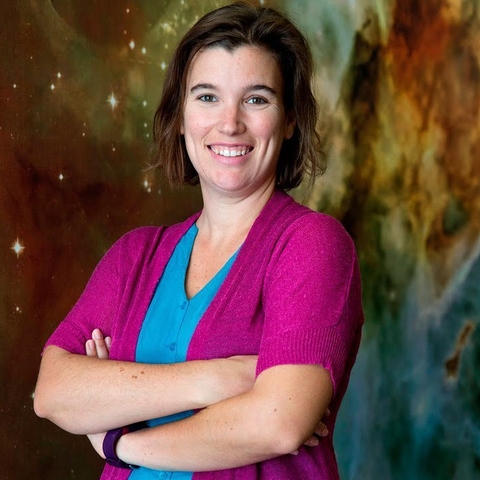
Persis Drell, director of the Stanford Linear Accelerator and professor of physics at Stanford, gives the keynote address for the joint symposium for the New York state sections of the American Physical Society and the American Association of Physics Teachers at Cornell April 18. Read More
Cornell's
Laboratory for Elementary-Particle Physics studies
nature's fundamental particles and the laws that govern them. These
studies shed light on questions like: how did the universe evolve? What
is the nature of space and time? What, really, is mass?
LEPP physicists also develop the technology behind accelerators,
which are our central window onto nature at its tiniest and are a vital
tool for other sciences that explore nature at the scale of atoms and
molecules.
LEPP communicates widely about its research in order to deepen
public understanding of the physical sciences, improve scientific
literacy, and share the excitement of discovery.
LEPP, the
Cornell University Laboratory for Elementary-Particle Physics, has joined with
CHESS to become the Cornell Laboratory for Accelerator-based Sciences and Education
(CLASSE). LEPP's primary source of support is the
National Science Foundation.