We’ve built a new site! You can make your way there by clicking here.
If you are having trouble finding what you need, please email comms-classe@cornell.edu.
CORNELL LABORATORY FOR ACCELERATOR-BASED SCIENCES AND EDUCATION
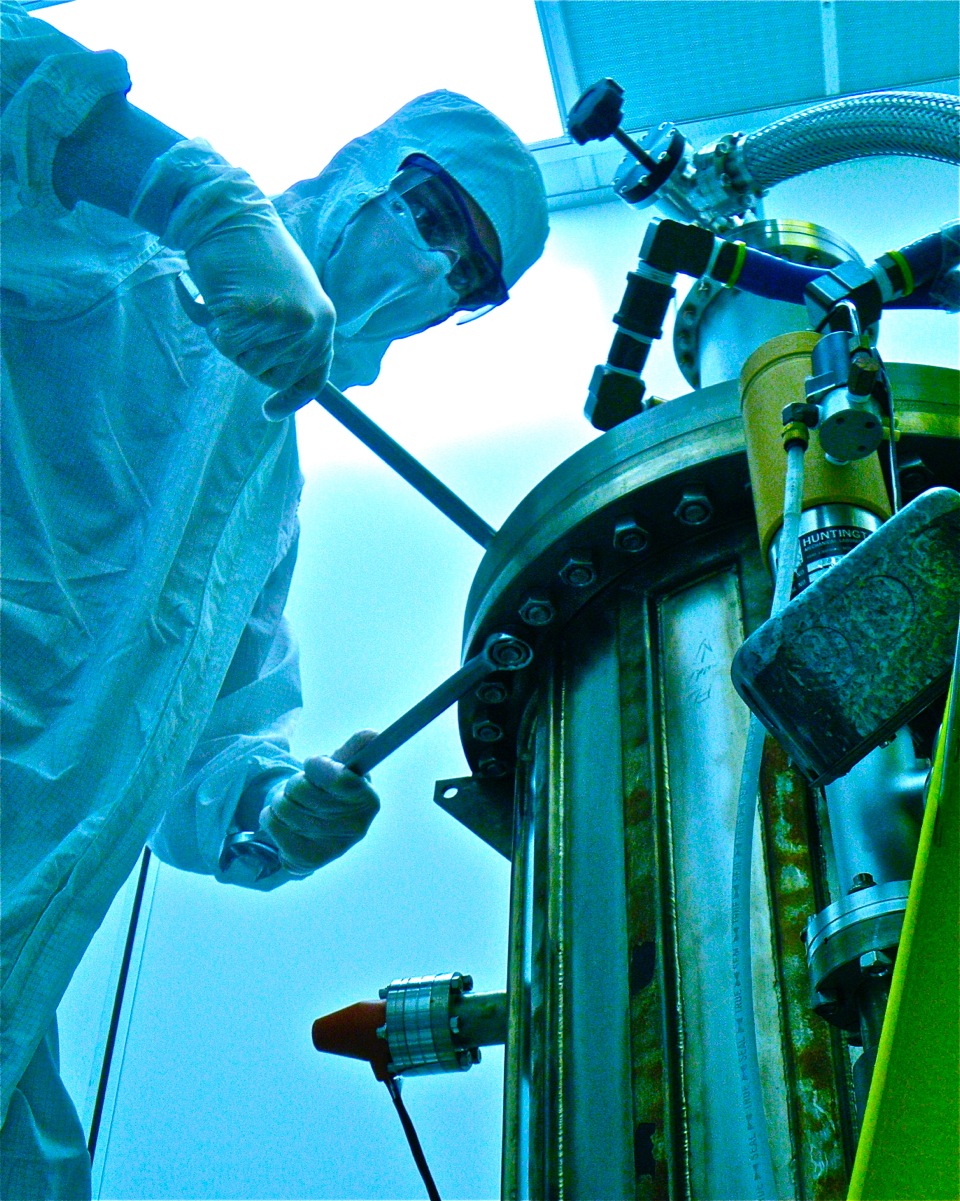
Grad student Sam Posen with his high temperature vacuum furnace for the production of Nb3SN via vapor diffusion.
The SRF group at Cornell is dedicated to the study of the basic phenomena and application of superconductivity in high frequency conditions. The first
use of SRF cavities in a high energy physics accelerator was in 1975 at Cornell's 10 GeV synchrotron. From the beginning, and even now, Cornell's SRF
group has been a world-wide leader in the field of RF superconductivity and its application to high energy accelerators and synchrotron light sources.
The SRF Laboratory occupies a significant portion of Newman Laboratory on the Cornell campus. Laboratories include extensive clean-rooms for cavity
construction. Once constructed, SRF cavities go through multiple stages of high-pressure rinsing, electropolishing, and high-temperature baking, all on-site
at Newman Lab. After cleaning, cavities are then tested under different loaded conditions, in single-cell and multi-cell arrangements.
Faculty: Donald Hartill, Georg Hoffstaetter, Matthias Liepe